Turn spare baggage into a delivery network.
Every day, millions of people fly with empty space in their luggage allowance — while someone, somewhere, is paying a fortune to move a small item along the exact same route. Offload came to us with a simple idea to close that gap: a marketplace that connects senders who need something carried with travellers already making the trip.
The brief was to design and build a two-sided mobile app from scratch. A sender posts what they need moved and where; a traveller heading that way offers to carry it in their spare allowance and earns a fee for the space. We were asked to shape the whole experience in Figma and ship it as a single cross-platform Flutter app for iOS and Android.
Two audiences, one app, total trust.
A peer-to-peer marketplace only works if both sides feel safe. Senders are handing an item to a stranger; travellers are agreeing to carry something on their behalf. The product had to make each side feel in control at every step — from posting a request, to agreeing terms, to handover — without drowning either in friction.
On top of the trust problem sat a structural one: the same app had to serve two very different mindsets. A traveller thinks in routes and dates; a sender thinks in items, destinations, and price. We had to design a single, coherent app that let a person be both — request something today, carry something tomorrow — without ever feeling like two apps bolted together.
Match on intent, build for both roles.
One identity, two roles — every user can send and carry. The app remembers context and surfaces the right flow rather than forcing people to pick a lane on sign-up.
Requests meet trips — senders post what they need moved and where; travellers publish their routes and dates. The matching logic brings the two together so a request finds the travellers who can actually fulfil it.
Trust as a feature — clear profiles, transparent service fees, and a structured request-to-handover flow make the exchange feel accountable from first tap to delivery.
Designed in Figma, shipped in Flutter.
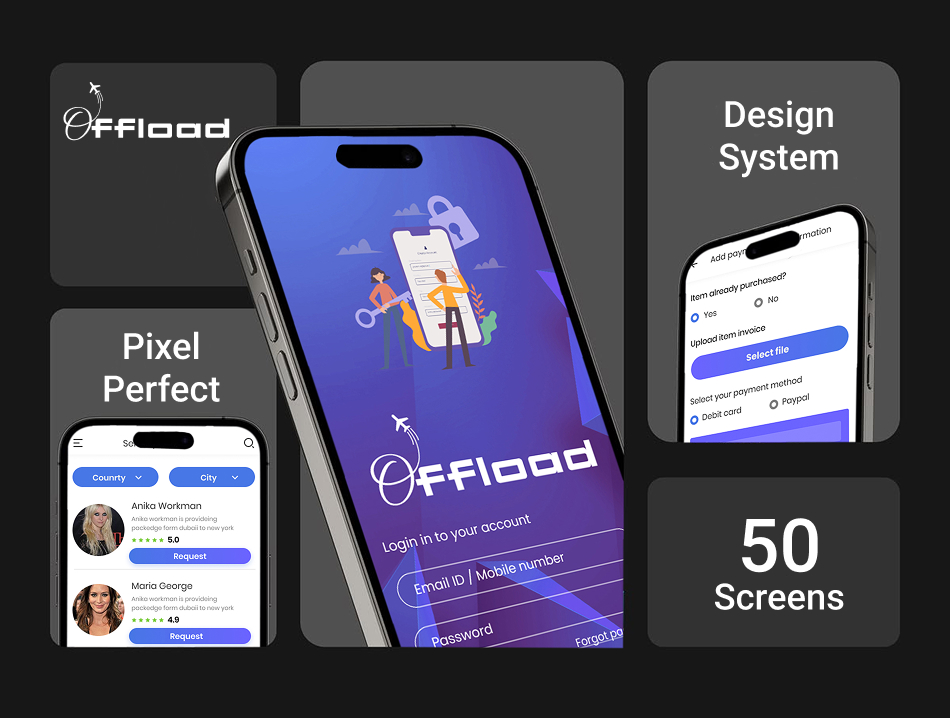
We designed Offload end to end in Figma — a complete component system covering onboarding, the sender and traveller flows, request creation, matching, offers, and the in-app agreement. Working in a shared design system meant the two roles felt like one product, with consistent patterns for cards, statuses, and actions across every screen.
The build is a single Flutter codebase in Dart, shipping to both iOS and Android from one source of truth. Flutter let us move the polished Figma motion and micro-interactions straight into production and keep the two platforms perfectly in sync — one team, one codebase, two native-feeling apps.
Core flows — posting a delivery request, browsing trips, sending and accepting offers, and tracking a request through to handover — were built as reusable, state-driven screens so the experience stays fast and predictable as the marketplace grows.

Flutter and Dart, one codebase.
Offload is built entirely in Flutter with Dart, giving both iOS and Android a single, maintainable codebase. That means every new feature — a change to the request flow, a new profile field, an update to the matching screen — ships to both platforms at once, at a fraction of the cost of two native builds.
The interface leans on Flutter's rendering engine to keep the marketplace feeling smooth: instant transitions between roles, responsive lists of requests and trips, and a design that stays pixel-faithful to the Figma file on every device size.
A marketplace ready to fly.
Offload launched as a polished, cross-platform app that lets anyone switch effortlessly between sending an item and earning from a trip they were already taking. The design makes a genuinely novel idea feel obvious, and the Flutter build means the founders can iterate on both platforms from a single team.
What started as a clever observation — that empty baggage is wasted capacity — is now a working product with a clear, trustworthy flow from request to handover, ready to grow its network of senders and travellers.
Project Gallery