
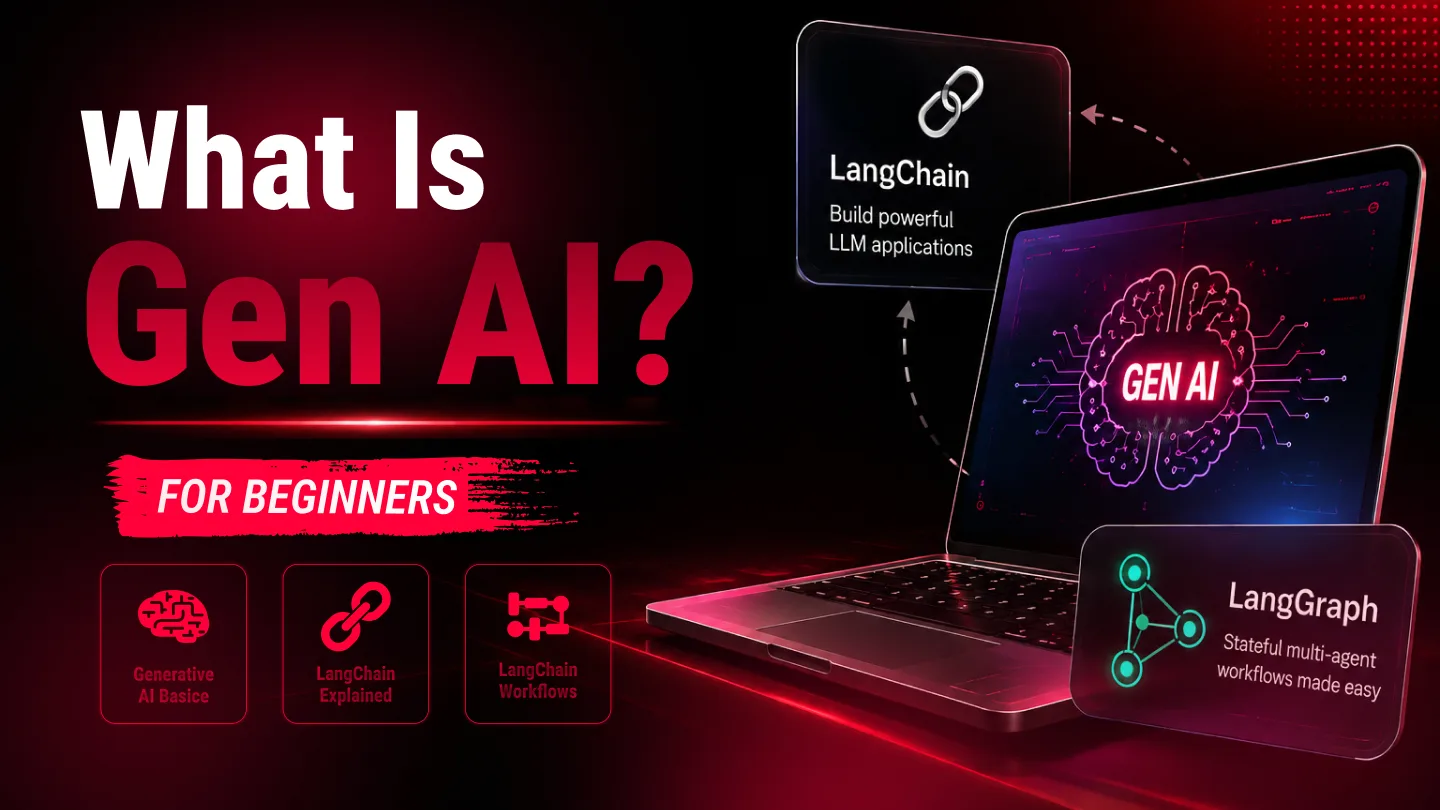
Generative AI (Gen AI) is AI that creates new content — text, code, images — from a prompt, powered by large models. LangChain is a framework that gives you the building blocks (models, prompts, memory, retrieval, tools) to wire a language model into a real app — ideal for chatbots and document Q&A. LangGraph is a framework for building stateful agents as a graph of steps, so your AI can loop, branch, use tools repeatedly, and recover from errors. Rule of thumb: LangChain for linear LLM apps, LangGraph for multi-step agents — and they work together.
If you've used ChatGPT, you've used generative AI. But there's a big gap between chatting with a model in a browser and shipping an AI feature inside your own product — one that knows your data, follows your rules, and does something useful reliably. Bridging that gap is exactly what frameworks like LangChain and LangGraph exist for. This guide explains all three from the ground up, with no assumed background.
What is generative AI, really?
Generative AI is a branch of artificial intelligence focused on producing new content rather than simply analysing existing content. Traditional (or “discriminative”) AI answers questions like “is this email spam?” or “which category does this image belong to?” Generative AI instead answers “write me an email,” “draw me an image,” or “write this function.”
Under the hood, most text-based Gen AI is powered by a large language model (LLM) — a model trained on enormous amounts of text that learns statistical patterns in language well enough to predict what comes next, one token at a time. String those predictions together and you get fluent, context-aware paragraphs, code, or answers. The same idea, applied to pixels or audio, gives you image and voice generation.
The important thing for builders is this: a raw model on its own is not a product. It doesn't know your customers, can't see your database, has no memory of previous conversations, and can't take actions in the world. Turning a capable model into something genuinely useful means giving it context, tools, memory, and guardrails. That's where frameworks come in.
Why you need a framework at all
You can call an LLM's API directly — and for a simple one-shot task, you should. But real applications quickly need more: pulling in relevant documents, remembering the conversation, formatting prompts consistently, calling external tools, chaining several steps, handling errors, and keeping costs sane. Rebuilding all of that by hand for every project is slow and error-prone.
Frameworks package these common patterns into reusable components, so you focus on your product instead of the plumbing. In the Gen AI world, the two names you'll hear most are LangChain and LangGraph — built by the same team, for two different jobs.
What is LangChain?
LangChain is an open-source framework for building LLM-powered applications. Think of it as a toolbox of standardised building blocks you can snap together:
- Model integrations — a consistent way to talk to many providers (so you can swap models without rewriting your app).
- Prompt templates — reusable, parameterised prompts instead of hard-coded strings.
- Memory — so a chatbot remembers earlier messages in a conversation.
- Document loaders & retrieval — load your PDFs, docs, or database rows, and fetch the relevant pieces at query time.
- Tools — let the model call functions, search, or hit APIs.
LangChain's signature use case is retrieval-augmented generation (RAG): connecting a model to your own knowledge so it answers from your content, not just its training data. A support bot that answers from your help centre, or an internal assistant that searches company documents, is classic LangChain territory. It shines when the flow is mostly linear — take input, retrieve context, prompt the model, return an answer.
What is LangGraph?
Some AI tasks aren't linear. An agent that researches a topic might need to search, read, decide it needs more, search again, use a calculator, and only then answer. It might hit an error and need to retry, or pause to ask a human for approval. Modelling that as a single straight chain gets fragile fast.
LangGraph is built for exactly this. It lets you design your AI application as a graph: nodes are steps (call the model, run a tool, check a condition) and edges define how control flows between them. Crucially, it is stateful — the graph carries information forward, so the AI can loop, branch on conditions, keep context across many steps, and resume where it left off.
That makes LangGraph the framework of choice for agents — AI systems that reason over multiple steps and use tools to accomplish a goal rather than answering in one shot. It also supports human-in-the-loop checkpoints (pause for a person to approve an action) and persistence (survive a crash and continue), which is what production reliability actually requires.
LangChain vs LangGraph at a glance
| LangChain | LangGraph | |
|---|---|---|
| Best for | Linear LLM apps, RAG, chatbots | Multi-step agents & workflows |
| Flow | Mostly straight-line chains | Graph with loops & branches |
| State | Lightweight / per-call | Persistent, shared across steps |
| Control | Simple, fast to build | Fine-grained, reliable, resumable |
| Human-in-the-loop | Limited | First-class support |
| Reach for it when… | You need an answer from your data | You need an agent that acts |
They are not competitors — they're layers. Many production systems use LangChain's model wrappers, retrievers, and tools as the components, and LangGraph as the orchestration layer that decides how those components run and repeat.
Which should a beginner start with?
Start with the simplest thing that solves your problem:
- Just need an answer or a chatbot over your docs? Begin with LangChain and a basic RAG setup. You'll learn prompts, retrieval, and models — the fundamentals of every Gen AI app.
- Need the AI to take multiple steps, use tools in a loop, or make decisions? Move to LangGraph. Model the flow as nodes and edges, and add human approval where the stakes are high.
- Building something serious for production? Expect to use both, plus monitoring, evaluation, and cost controls. This is where an experienced team pays for itself.
Whatever you choose, resist the urge to over-engineer. The best Gen AI products start narrow — one clear task, done reliably — and grow from there.
- Gen AI creates new content from a prompt; a raw model isn't a product until you add context, tools, and guardrails.
- LangChain gives you reusable building blocks — best for chatbots, Q&A, and RAG over your own data.
- LangGraph models AI as a stateful graph — best for multi-step agents that loop, branch, and use tools.
- Rule of thumb: LangChain for linear apps, LangGraph for agents — and they combine.
- Start simple, ship one reliable task, then expand.
At Dezvo we build production Gen AI systems end to end — from generative AI development and LLM integration to custom AI agent development with LangChain and LangGraph. Tell us what you want to build and we'll help you choose the right approach — and ship it.