
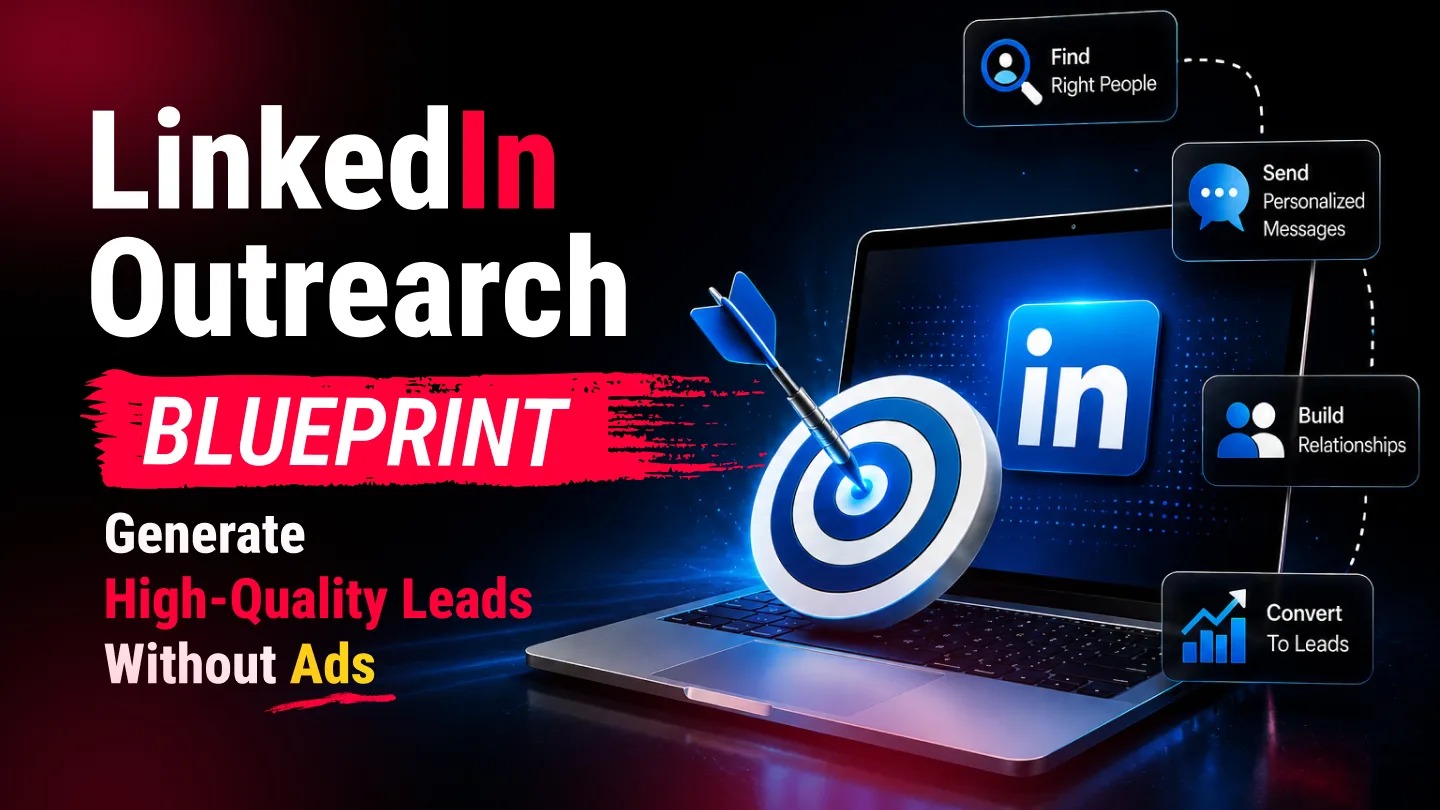
To generate high-quality leads on LinkedIn without ads, run a disciplined organic system: (1) turn your profile into a landing page for your ideal buyer, (2) define a sharp ICP and build a targeted prospect list, (3) send personalised connection requests (15–25/day), (4) open conversations with relevance and value — never a hard pitch, (5) follow up consistently, (6) post content that builds trust, and (7) track everything so you can improve. Consistency, not budget, is what fills the calendar.
Paid ads have their place, but for most B2B services and software companies, the highest-ROI channel on LinkedIn is still organic outreach — direct, personalised conversations with the exact people you want to work with. Done right, it books qualified calls at near-zero media cost. Done wrong, it's spam that burns your reputation. This blueprint keeps you firmly in the first camp. Let's walk through it step by step.
Step 1 — Turn your profile into a landing page
Before you send a single message, fix your profile. When a prospect gets your request, the first thing they do is check who you are — and your profile decides whether they accept. Treat it as a landing page for your ideal buyer, not a résumé.
- Headline: state who you help and the outcome you deliver — not your job title. “I help [audience] achieve [result]” beats “Founder at Company.”
- Banner & photo: a clear, professional photo and a banner that reinforces your value proposition.
- About section: speak to the prospect's problem, show proof, and end with a soft call to action.
- Featured: pin a case study, lead magnet, or booking link so interested visitors can act immediately.
Your outreach conversion is capped by your profile. Fix this first and every later step performs better.
Step 2 — Define a razor-sharp ICP
The fastest way to waste outreach is to message the wrong people. Define your Ideal Customer Profile (ICP) precisely: industry, company size, role/seniority, geography, and the trigger that makes them a good fit right now. The tighter your ICP, the more relevant your messages, and the higher your reply rate.
Use LinkedIn's search filters (Sales Navigator if you have it) to build a focused prospect list that matches your ICP. Aim for relevance over reach — a list of 200 perfect-fit prospects beats 2,000 vague ones every time.
Step 3 — Send personalised connection requests
Now start connecting — carefully. Send 15–25 personalised requests per day to stay safely within LinkedIn's limits and protect your account. Blasting hundreds of generic requests is the fastest route to restrictions and a wrecked reputation.
Two schools of thought both work: a short, personalised note referencing something specific about them, or a clean request with no note at all (which can see high accept rates). What never works is pasting a sales pitch into the connection note. The goal here is simply to get connected — you'll earn the conversation next.
Step 4 — Open conversations, don't pitch
This is where most people fail: they connect, then immediately dump a sales pitch. Instead, open a genuine conversation. A simple, effective flow:
- Warm opener: thank them for connecting and reference something relevant — their work, a post, a shared interest.
- Relevance / value: share a useful insight, ask a thoughtful question, or offer something helpful with no strings.
- Soft transition: once there's a real exchange, gauge fit and suggest a short call — only if it's genuinely relevant to them.
Lead with curiosity and value; earn the meeting over a few messages. People buy from people they trust, and trust is built in the conversation, not the connection request.
A message that works
“Thanks for connecting, [Name] — I really liked your post on [topic]. Curious: how are you currently handling [specific challenge]? We've helped a few [their type of company] with exactly that and I'm always comparing notes.” Short, relevant, no pitch, opens a reply.
Step 5 — Follow up (this is where the deals are)
Most replies — and most booked calls — come from the follow-up, not the first message. People are busy; a polite, spaced follow-up is not annoying, it's professional. Send 2–4 follow-ups over a couple of weeks, each adding a little value rather than just “bumping” the thread.
Keep them light: share a relevant resource, a quick idea, or a case study. If they're not interested, move on graciously — and keep them in your network for future content and warming.
Step 6 — Post content that builds trust
Outreach and content compound each other. When you post consistently about your prospects' problems, your outreach lands warmer — they've seen your name, your ideas, your proof. Aim for 2–3 posts a week focused on your audience's challenges, results you've delivered, and useful frameworks. Content turns cold outreach into warm outreach.
Step 7 — Track, measure, improve
What gets measured gets better. Track your funnel so you know where to fix things:
| Metric | What it tells you |
|---|---|
| Connection accept rate | Profile & targeting quality |
| Reply rate | Message relevance & opener |
| Conversation-to-call rate | Fit & transition timing |
| Calls booked / week | Overall system health |
Use a simple CRM or spreadsheet, review weekly, and change one variable at a time. Small improvements at each stage multiply into a dramatically bigger pipeline.
- Fix your profile first — it caps everything downstream.
- A sharp ICP and targeted list beat mass, generic sending every time.
- Keep requests to 15–25/day, personalised, to protect your account.
- Open conversations, don't pitch — earn the call over a few messages.
- The money is in follow-up; content makes cold outreach warm; tracking makes it repeatable.
Want this running without eating your week? Dezvo builds done-for-you B2B lead engines — combining LinkedIn outreach with email marketing, social content, and smart AI automation for tracking and follow-up. Tell us who you want to reach and we'll build the system.